

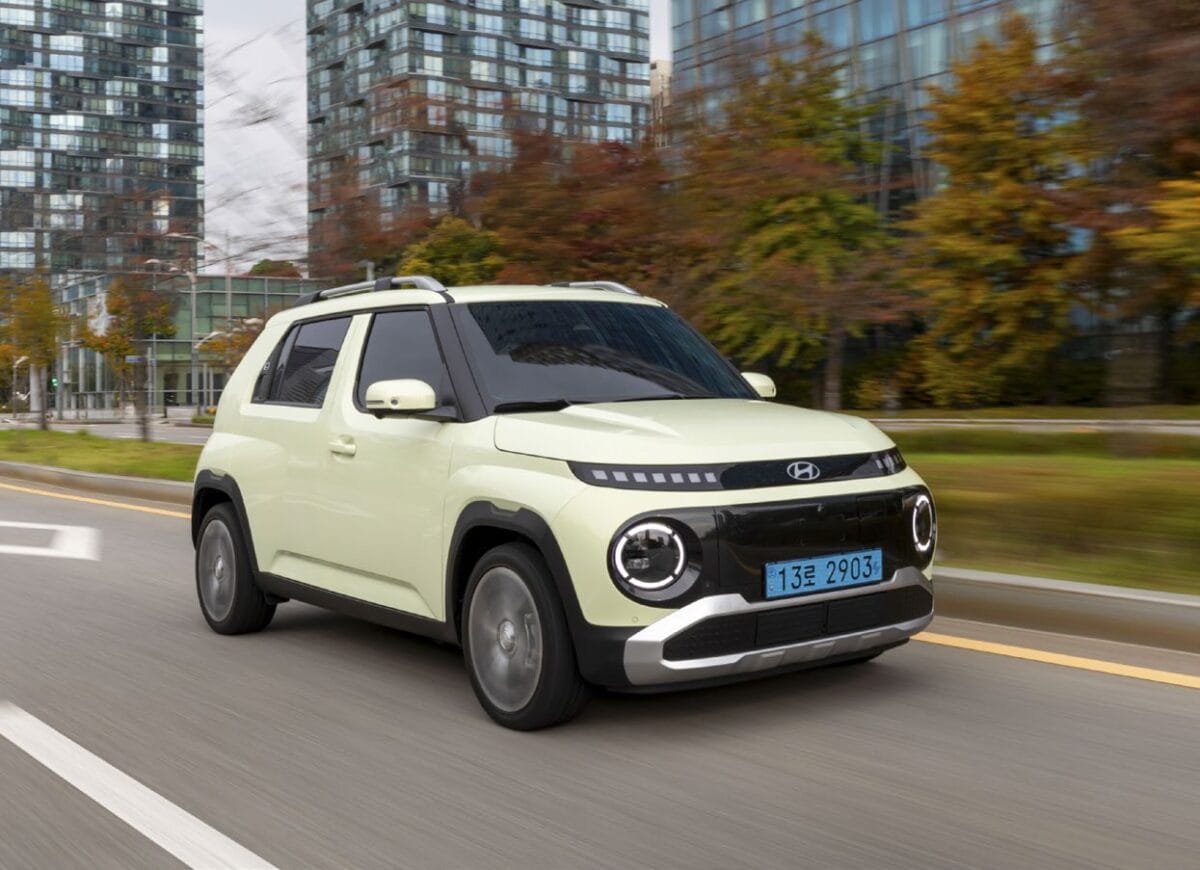
Smaller cars like the Hyundai Inster could pave the way for mass adoption of EVs, writes James Stinson.
Up to now, most electric cars on our roads have been larger, more expensive models. That’s because the economics of electric have been challenging, and bigger cars generally have bigger margins. In recent years though the price of batteries has fallen considerably, making it easier for manufacturers to earn a buck on smaller cars. There’s been a surge in small EVs coming to market over the last 18 months. Cars like the Dacia Spring (from £14,995), Citroen e-C3 (from £22,000), Renault 5 (from £23,000) and others have brought electric motoring within the reach of many more drivers.
And it’s likely these new smaller, cheaper electric cars will boost sales and help drive the mass adoption of EVs. Not only are they more affordable but these smaller, city cars are arguably better suited to the job of electric motoring. Distances are much shorter, so range never becomes an issue. Petrol cars still hold the edge over longer distances, for towing etc but in the city, it’s a no brainer – electric is king. The point is well made by this Hyundai Inster.
The Korean marque has been blazing a trail in EV motoring with a clutch of fine cars – the Kona Electric, Ioniq 5, Ioniq 6 saloon and the enormous Ioniq 9, seven-seat SUV. The Inster isn’t as big, luxurious or as flexible as those but it’s by far the most fun to drive round Belfast’s crowded streets and car parks. Much of that is thanks to the Inster’s diminutive size. It has a tiny footprint – just 3.8m long and around 1.6m wide – which becomes apparent when you easily slip into an otherwise tight driveway or challenging car park space. But it’s not a small car. The Inster sits upright with straight sides and a tall roof, which will accommodate even six footers comfortably.
Hyundai has doubled down on the boxy styling with an overall futuristic look, which sits apart from its stablemates and other city cars. It turns heads. It comes with a choice of two battery sizes. The Standard Range has a 42kWh battery and gives you an official range of 203 miles. The Long Range version, with its bigger 49kWh battery, can officially manage up to 229 miles. It’ll come closest to delivering those numbers if you use it mostly in and around town. The Inster Long Range also gets more power, with 113bhp against 95bhp for the Standard Range. It’s capable of a 0-62mph time of 10.6 seconds. That’s not quick by electric car standards but it feels perky enough in town, zipping through traffic with ease.
The Standard Range’s delivers a more leisurely 11.7-second 0-62mph time. Both will go from 10-80% charge in about half an hour with a 150kW public EV charger. There are three trim levels – 01, 02 and a rugged looking Cross variant. Prices start from £23,505 for the 01 but the 02, from £26,755, is the pick of the bunch. Not only do you get a bigger battery with longer range and better performance, it also includes sliding and reclining rear seats and a folding front passenger seat, significantly boosting the little Inster’s practicality. The Inster gets plenty of standard equipment regardless of which version you go for.
Indeed, entrylevel 01 trim includes 15-inch alloy wheels, single-zone climate control, automatic windscreen wipers, an EV heat pump and battery heater, keyless entry and start, and other kit. The 02 trim – which is only available on the Inster Long Range – adds even more kit. That list includes 17-inch alloy wheels, heated front seats, an auto-dimming rearview mirror, a heated steering wheel and wireless phone-charging. The cabin is really neat too. There’s a responsive and easy-to-use 10.3-inch touchscreen on the dash and another 10.3-inch driver’s display behind the steering wheel. Hyundai gets serious brownie points for retaining proper buttons for the aircon/heating controls. It’s comfortable and spacious, for drivers and passengers, especially in the rear, which belies its compact dimensions.