

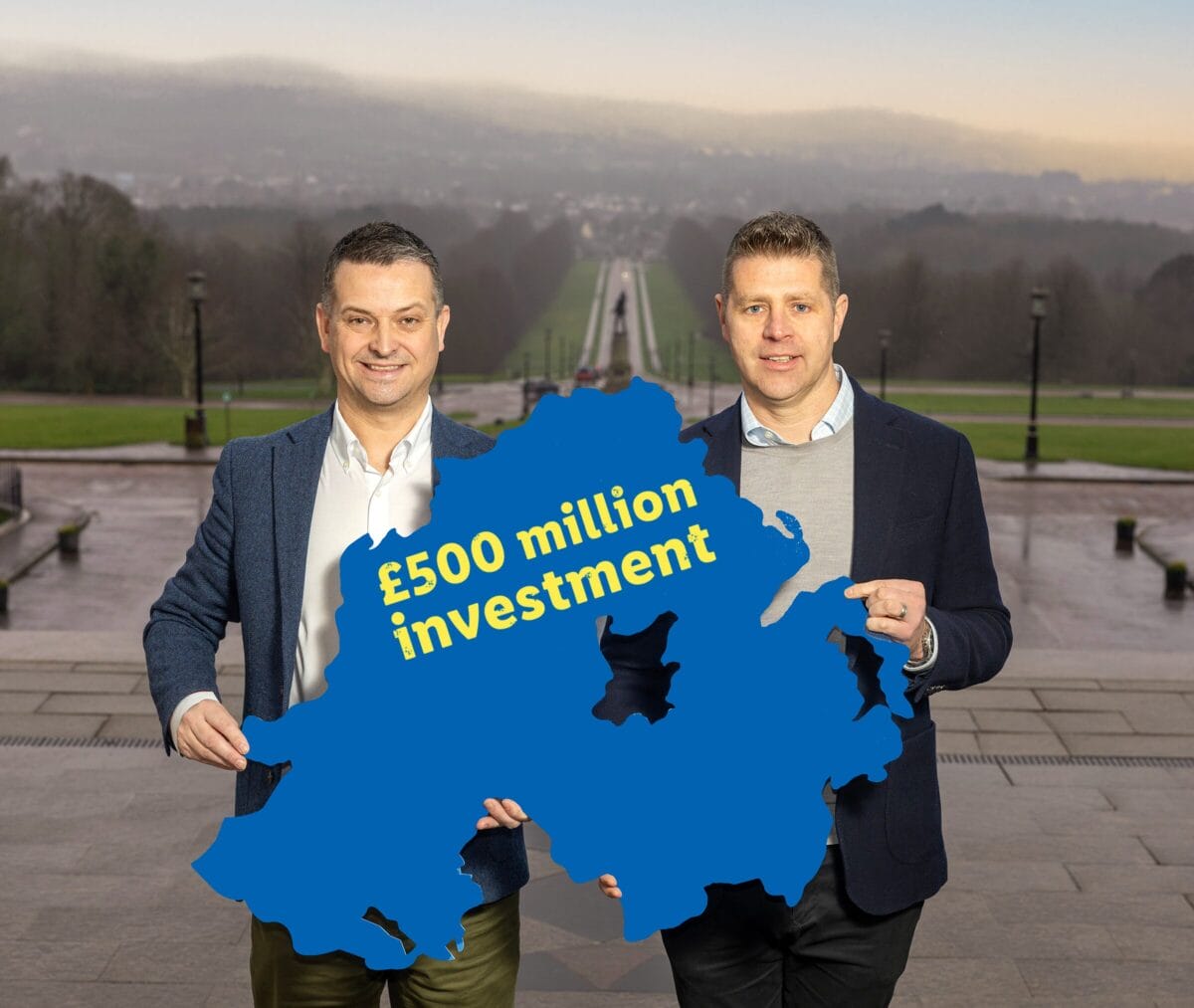
Lidl Northern Ireland’s economic contribution (GVA) to Northern Ireland could increase by almost half-a-billion pounds per year from 2032 onwards …but only if the region’s planning system was given a new lease of life.
The retailer says it plans to grow its footprint to more than 60 stores across Northern Ireland by 2032, underpinned by an investment of £500 million in expanding its presence across the region. This expanded store network would support an additional £475 million in GVA per year once fully operational – however the retailer pointed out that this is “entirely contingent on the Planning system”.
Lidl, which currently has 44 stores across Northern Ireland, unveiled the study this morning at Stormont Parliament Buildings, where senior representatives from the business met with Ministers, MLAs and departmental officials to showcase a range of employment, community, supply chain and sustainability initiatives.
Authored by KPMG, the study provides an independent, evidence-based assessment of the potential economic and social value of Lidl’s proposed store developments across Northern Ireland. It considers how Lidl’s investment supports economic activity, employment and local supply chains, alongside wider social and community outcomes.
Key findings in the report include:
- Between 2026 and 2031, Lidl store development and construction in Northern Ireland – to include more than 16 new store openings – are expected to support an additional £281 million in GVA, driven by capital investment and construction-related supply chain effects.
- Around 3,000 (2,966) jobs will be supported during this development phase (measured in job-years), equating to £118 million in wages and £36 million in income tax revenues.
- Once additional stores are fully operational from 2032 onwards, Lidl’s expanded network of new stores will support an additional £475 million in GVA per year through ongoing retail operations and local spending – taking its total GVA in Northern Ireland to more than over £835 million per year.
- Approximately 2,400 (2,372) jobs will be supported from 2032 onwards, equating to £67 million in wages, £17 million in income tax revenues, and £3.2 million in non-domestic rates.Robert Ryan, Chief Executive Officer Lidl Ireland and Northern Ireland said:“Having opened our first store in Northern Ireland 26 years ago, we know the importance and the impact of sustained, long term investment in the local economy.“Our store development pipeline is a material investment that supports the Northern Ireland Executive’s economic and social priorities. Furthermore, evidence shows that retail-led investment of this nature converts private capital into local jobs, wages, tax revenues and improved access to essential goods, delivering public value without additional public spending.“Alongside this significant economic impact, locally and across the region, each new Lidl store brings stronger local connections and increased capacity to support employees, charities and grassroots organisations in communities across Northern Ireland. “We have clearly outlined our commitment to Northern Ireland and our ambition to grow here,” he continued. “This study reinforces our potential economic and social impact in the region – underpinned by our £500 million expansion investment – but our ability to realise this impact is contingent entirely on the Planning system.” In December 2025, Lidl expressed concerns around major delays in securing planning permission for its proposed second store in the city of Derry-Londonderry at Crescent Link Retail Park. The proposed £8 million development has now been in the Planning system for more than six years (366 weeks – as of 17 February 2026), having initially been approved by Derry City and Strabane District Council and later called in for review by the Department for Infrastructure in October 2021.Gordon Cruikshanks, Regional Managing Director for Lidl Northern Ireland commented: “Our ongoing challenges in Derry-Londonderry are particularly frustrating, given that our sole existing store there records the highest footfall of our entire store network in Northern Ireland and one of the highest footfalls in the entire international Lidl store network – pointing to exceptionally strong customer demand for our proposition in the city.“However, like many businesses, we encounter challenges right across the planning system at both local and central government level in Northern Ireland, and this is hindering economic growth. Rather than acting as an economic lever, these delays, inconsistencies and uncertainty in the system defer investment, reduce scale and limit the realisation of economic and social benefits. “Lidl’s geographically distributed store network means that we are well-placed to support inclusive growth, resilient communities and shared prosperity right across Northern Ireland. We remain committed to engaging proactively with elected representatives, officers and departmental officials to overcome planning-related challenges so that we can realise our full social and economic impact here.”For more information, please visit lidl-ni.co.uk